The public can react to crises in a wide variety of ways, but let me start with the least common public reaction to a crisis: panic. Panics are truly horrific when they happen – but they don't happen often, especially in the West and in the absence of intoxicating substances.
In the stairwells of the World Trade Center on September 11, 2001, survivors tell us, many people felt panicky, but their behavior was calm, orderly, helpful to others, sometimes even heroic. The panic attacks came later, when the crisis and the need for urgent action were over.
The impression that people are panicking and the prediction that they are likely to panic aren’t just mistakes, they’re dangerous mistakes. The impulse to “avert” panic too often leads authorities (and sometimes even journalists) to sound over-reassuring, withholding or shrugging off information they consider too alarming for the public to tolerate. Paradoxically, this may actually increase the probability of panic, as people come to feel that those in charge are “handling” and misleading them instead of leveling with them.
Denial and Apathy
While panic is rare, another extreme reaction, denial, is fairly common. Denial, in fact, is why panic is rare; people at risk of panicking usually trip a mental circuit-breaker and go into denial instead. The dangerous thing about denial is that people in denial often do not take precautions in a crisis (or the run-up to a crisis), and this leads to more harm to themselves and others.
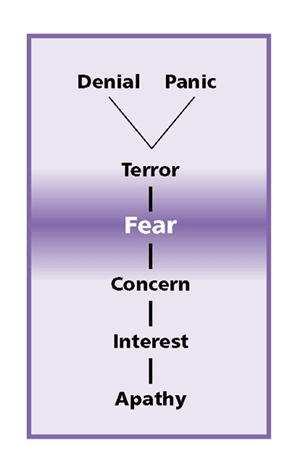
Apathetic people, of course, also fail to take precautions. In communication terms, the problem with denial is that it looks a lot like apathy. The difference is that apathy responds well to scary warnings – but that’s a devastatingly wrong prescription for denial, since it only forces us deeper into denial. Nor will over-reassurance work for denial; it colludes with the denial and thus deepens it.
The strongest antidote to denial is, paradoxically, the legitimization of fear. If it’s okay to be afraid, then I don’t have to deny my fear and can find ways to tolerate it instead.
Crisis managers often find even modest levels of public fear intolerable, which may be why they interpret the fear as panic. The public, on the other hand, can usually tolerate its own fear fairly well, especially if there are things we can do to protect ourselves (as psychiatrists and soldiers have long recognized, action binds anxiety). We’re hard-wired to respond fearfully to new dangers; that response is more conducive to survival than fearlessness would be. In fact, it’s arguable that we tend to recover rather too easily from fear. We quickly get used to the New Normal, relaxing our vigilance and our sense of shared urgency.
Finally, note that when people become suddenly afraid of X, they typically become less afraid of Y and Z, and less vulnerable to free-floating anxiety. For the most part, each individual is as anxiety-prone and fear-prone as he or she is wired to be. We allocate our fear. During a crisis, we are temporarily more afraid – we draw on a reservoir of untapped fearfulness. But very quickly we revert to our normal level of fearfulness – but with more of our normal fear attached to the new risk, and less of it available for other risks.
What level of public fear should be the goal of crisis managers? Panic, denial, and apathy are all undesirable extremes. So is terror; that’s the terrorists’ goal. But if terror is too strong a response, mere interest or concern is too weak. In a crisis, we want people to put their ordinary concerns aside, to be vigilant, to take precautions, to tolerate inconveniences. Fear isn’t the problem in a crisis. It is part of the solution.
Empathy and Its Siblings
But of course fear isn’t the only emotional response to crisis. Just as important is the empathy/misery/depression complex of emotions. One of the principal reactions to September 11 was and still is a sense of shared misery. Most people expect to survive whatever the terrorists throw at us. But we expect to have to watch a succession of terrorist attacks on CNN. Whether or not life got scarier after 9/11, it certainly got more miserable. To a lesser but significant extent, all calamities provoke misery.
It is important to distinguish empathic over-reactions – misery, even depression – from fear and its relatives. For officials to tell a miserable person to calm down misses the point; we’re calm already. There is a prescription for misery, however:
- Acknowledge and help us acknowledge that misery is part of what we’re feeling.
- Affirm that in a situation like this misery is appropriate to feel.
- Let us know you feel it too.
- Expect us (and yourself) to bear it, and in time to get past it.
- Suggest empathic actions, ways we can help others. (One important corollary: Planning to make suitable use of volunteers is a crucial aspect of emergency preparedness.)
Anger, Hurt, and Guilt
Anger is also an appropriate reaction to crisis, especially to terrorism. It is functional; it fuels resolve, vigilance, and precaution-taking. Of course it can also fuel scapegoating and harassment. Not all angry behaviors are useful, though the anger itself is. But when anger escalates into rage or flips into denial, it is no longer functional. Legitimizing the anger is one important way to keep this from happening.
Hurt is often underrated as a response to crisis. I’m talking about injured self-esteem: “Why did this happen to me?”
Once again terrorism crises are an extremely vivid example. After 9/11, virtually everyone was asking the bewildered question, “Why do they hate us so?” This is an important question to ask and try to answer. But not everyone was looking for answers; many just wanted to express their hurt feelings. We preserve our sense of goodness with overly simple answers: they’re evil; they envy our good life; they hate our freedoms. Hurt, too, can flip into denial; it’s hard to hold onto the idea that people actually hate you so much they want to kill you.
Guilt also plays an important role – caretaker guilt (“I feel powerless to protect my family, my community, my constituents”); survivor guilt (which results largely from projected relief: “I’m okay and they’re not”), and above all guilt at continuing to be preoccupied with our own mundane concerns.
A Minnesota County Commissioner who is also a florist told me about all his wedding customers in the days and weeks after 9/11. Shipments of flowers (among other things) were disrupted, and his customers were worried about the flowers for their weddings. But they also felt guilty about worrying about such things. So he learned that he not only needed to reassure them that they’d have their flowers; he had to reassure them that we all need beauty right now, that their floral worries were not wrong or selfish.
The Value of “Over-Reacting”
Fear, misery, anger, hurt, and guilt are all normal responses to crisis (for crisis managers as well as the public!). But we bear them and we get beyond them – perhaps not immediately, perhaps not easily, but we do it. Resilience is also a normal response to a crisis. Call it post-traumatic growth.
Strong emotional reactions are especially likely, and especially important, at the start of a crisis. This is particularly true of fear; the other emotions tend to come later. Many crises start small or distant. They may stay small or distant, or die out altogether – or they may get bigger and closer. Like a hurricane or a forest fire, they capture our attention before we are actually in danger.
That’s good; it’s a survival trait to worry about possible crises before they engulf you. One way people tend to worry about possible crises is to imagine that they are already crises. Thus, people may be “over-reacting” to what is currently happening to them as a way of getting ready for what may soon happen to them. This is especially appropriate for the sorts of crises that tend to grow quickly and without much warning. Infectious diseases, for example, can suddenly make the transition from a small localized problem to a serious epidemic, even a pandemic.
Terrorist attacks are like infectious diseases in this way, especially if you consider that terrorists may begin with a pilot project. One of the main reasons many people over-reacted to the 2001 anthrax attacks was in anticipation of more serious bioterrorist attacks to come. (People overreacted, but notice that they didn’t panic.) Most experts similarly expect another and much tougher bioterrorism challenge sooner or later. Reassurances about the low risk of the 2001 attacks very seldom acknowledged this, and so they sounded hollow.
The Adjustment Reaction
When someone first learns about a new serious risk, in other words, the natural and healthy and useful reaction is, in a sense, an over-reaction:
- 1.
- You pause and stop what you’re doing. In particular, you stop doing the things that might have suddenly become dangerous (spending time in tall buildings, for example) while you wait to see what’s going to happen.
- 2.
- You become hyper-vigilant – watching CNN for hours, checking Google News periodically, even scrutinizing strange-looking people in nearby cars and restaurant booths.
- 3.
- You personalize the risk – treating a risk that is already hurting others and may be coming your way as if it were actually here already.
- 4.
- You take precautions that are perhaps unnecessary, or at least unnecessary so far. You decide to go out for Mexican food instead of Chinese food (because you’re worried about SARS) – or Chinese food instead of Mexican food (because you’re worried about hepatitis) – or either one instead of a hamburger (because you’re worried about mad cow disease).
These responses are what psychiatrists call an “adjustment reaction,” a short-term phenomenon as you get used to the New Normal. They are functional psychologically, an emotional rehearsal that gets you ready to cope if you have to. But they’re a logistical rehearsal too. People who have gone through this adjustment reaction cope better with an actual crisis and recover better when the crisis (or the threat of crisis) is past.
From a risk communication perspective, this adjustment reaction period is the teachable moment. Officials should encourage people’s efforts to come to grips with the potential crisis, their struggle to figure out how to feel and how to act. They should guide the adjustment reaction toward effective and pro-social behaviors. They shouldn’t give in to their temptation to disparage or ridicule it.
Peter M. Sandman, Ph.D., is a risk communication consultant based in Princeton, NJ. This column is based on his essay in a soon-to-be-published manual for journalists entitled “Terrorism and Other Public Health Emergencies” (U.S. Department of Health and Human Services, 2005). Jody Lanard, M.D., Dr. Sandman’s wife and colleague, collaborated in the development of many of the ideas in this article. For more information on crisis communication and public reactions to crisis situations, see http://www.psandman.com, especially http://www.psandman.com/articles/beyond.pdf. 
Copyright © 2005 by Peter M. Sandman